The Editions That Never Reached a Shelf: Reading the Silence Around Jikji's Lost Print Runs
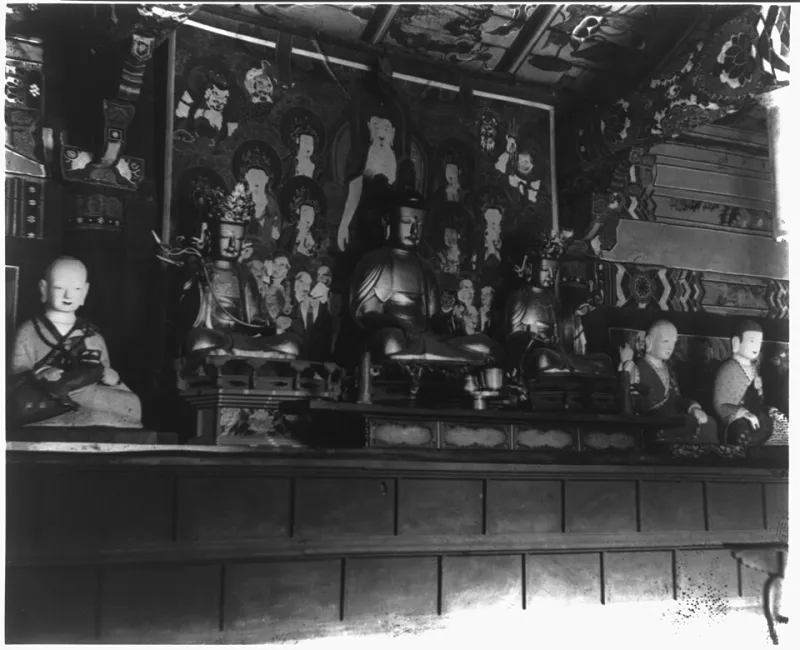
Photo: Genthe, Arnold, 1869-1942, photographer, Public domain, via Wikimedia Commons
Every account of Jikji begins with a number: 1377. It is a reliable number, taken from the colophon of the one surviving volume of Buljo jikji simche yojeol, printed at Heungdeoksa Temple near present-day Cheongju some seventy-eight years before Johannes Gutenberg's Bible came off a press in Mainz. The date holds. Nearly everything around it does not.
Chief among the unknowns is quantity. No record tells us how many copies the Heungdeoksa project produced, how many were distributed to temples and officials, how many were chanted from until the paper failed, or how many were folded into later bindings and lost inside other books. We know that at least one survived, because one survives: the second volume, held at the Bibliothèque nationale de France, where it was brought to scholarly attention in 1972. Beyond that single witness, the edition is inference.
That silence deserves attention — not because it conceals a scandal, but because it exposes how printing history, and innovation history more broadly, is usually written. We narrate from the survivors and call the result a trend.
A Single Copy Is Not a Print Run
Museum labels frequently note that Jikji survives in only one known copy. Visitors reasonably hear this as a statement about rarity, as though the book had always been singular, a precious object set apart from its first day. It is instead a statement about loss. There is no evidence that the 1377 printing was small, and no evidence that it was large. There is only the fact that of whatever number existed, one is known today.
This distinction matters because it changes the moral of the story. A book that was always unique tells us about devotion and craftsmanship. A book that was once one of many, and is now alone, tells us about fragility, circulation, and the ordinary accidents of survival — which is the more useful lesson for anyone thinking seriously about how knowledge travels.
What Goryeo Printing Records Actually Suggest
Korean printing of the Goryeo and early Joseon periods was often project-based rather than commercial. A temple, a court bureau, or a patron commissioned a text; the resulting copies were given as acts of merit, distributed to monastic libraries, presented to envoys, or stored for future reprinting. Print runs in this environment could be substantial, but their purpose was dissemination within a bounded network, not sale to an anonymous market.
We also know, from colophons and later citations, that some projects left no physical trace whatsoever. The metal type used for the Sangjeong Gogeum Yemun in the thirteenth century is documented in later sources but attested by no surviving copy. If a project of that scale could vanish entirely, the absence of Jikji's other copies is unremarkable rather than mysterious.
Fire, war, and reuse did the rest. The Japanese invasions of the 1590s destroyed temples and their libraries across the peninsula. Paper was routinely recycled — pasted into mountings, used as backing, cut for pattern books. And from the late nineteenth century onward, removal by foreign collectors and diplomats scattered Korean material into European and North American institutions, often without documentation of provenance. The French copy is itself a product of that era of acquisition.
Failure as Evidence
American culture has a strong appetite for the disruption narrative: a better tool appears, the old method collapses, and the world reorganizes around the winner. Movable metal type fits that template neatly — except that in Korea it did not behave that way. Woodblock printing remained the dominant technology for centuries after 1377, and for good reason. For a text printed repeatedly in large numbers, carved blocks were economical and durable. Metal type rewarded variety and speed of composition, not volume. The two methods coexisted because they solved different problems.
Judged by market share, movable type in fourteenth-century Korea was not yet a success. Judged by technical achievement, it was extraordinary. Both statements are true, and printing history is poorer when institutions present only the second.
There is a broader point here for readers accustomed to stories about innovation winners. Adoption curves are built from the visible; the invisible — the editions that were printed once and never again, the scripts that were abandoned, the workshops that closed — rarely make it into the exhibit. Yet the failures carry the evidence about cost, patronage, literacy, and infrastructure that the successes conceal.
Curating the Absence
The practical question for museums is how to display a gap. A label that reads “the only known copy” invites visitors to admire rarity. A label that reads “no one knows how many were printed; here is what we can and cannot establish” invites them into method — into the reasoning that makes history a discipline rather than a list of objects.
Curators can go further. A simple graphic showing the known copy against the unknown remainder can make uncertainty visible. A short wall text on the physical vulnerabilities of hanji and on the colonial-era dispersal of Korean collections can explain why survival was a matter of luck as much as merit. And an honest sentence about the woodblock tradition's persistence can prevent visitors from leaving with a tidy, and false, story about inevitable progress.
The missing editions of Jikji are not a footnote to its fame. They are part of the record, and they argue for a more disciplined kind of admiration: one that honors the achievement of 1377 without pretending that its afterlife was simple, linear, or fully known.