Fragile Pages, Lasting Change: How Jikji Rewired the Science of Conservation in American Museums
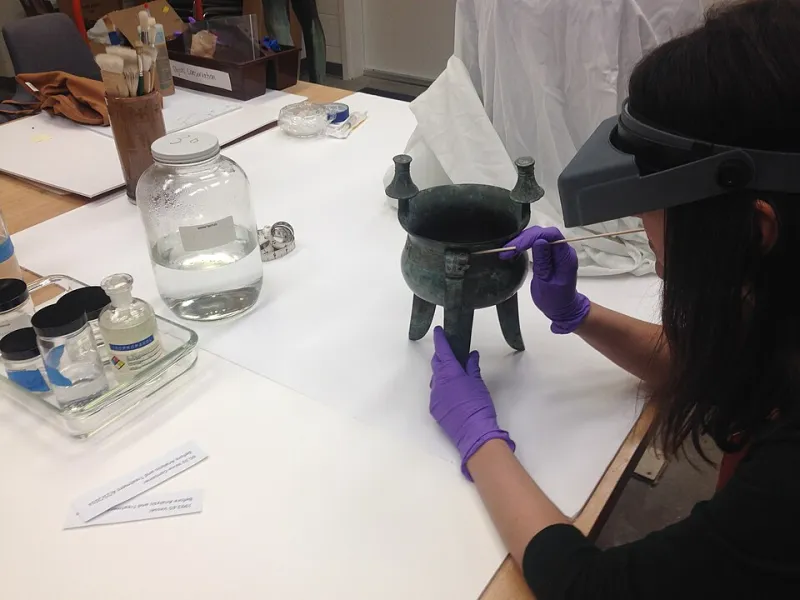
Photo: RichardMcCoy, CC BY-SA 3.0, via Wikimedia Commons
In the autumn of 2001, a small cohort of conservators at a major East Coast research museum gathered around a worktable to examine newly acquired facsimile materials related to Jikji — the fourteenth-century Korean Buddhist compendium widely recognized as the oldest surviving book produced with movable metal type. The original, housed at the Bibliothèque nationale de France in Paris, was unavailable for direct study. But the questions it raised were very much present in that room. How would an institution handle a manuscript of such extreme fragility? What environmental conditions would it require? And, perhaps most urgently, did American conservation departments even possess the technical vocabulary to address the unique material properties of East Asian printed artifacts?
For many institutions, the honest answer was: not yet.
Over the two decades that followed, the growing global prominence of Jikji — accelerated by its 2001 inscription on UNESCO's Memory of the World Register — became an unexpected catalyst for technical and procedural reform across American museum conservation departments. The changes were rarely announced with fanfare. They emerged instead through grant proposals, staff retreats, revised handling protocols, and the slow, unglamorous work of upgrading infrastructure. But their cumulative effect has been substantial.
A Fragility Crisis That Demanded New Answers
Conservators who specialize in East Asian materials have long understood that Korean and Chinese manuscripts present challenges distinct from those posed by Western printed books or parchment documents. The paper — often hanji, a fiber-dense Korean paper made from mulberry bark — responds differently to humidity fluctuations than European rag paper. The inks, binding structures, and pigments used in premodern Korean printing require different stabilization approaches. And the sheer age of artifacts like Jikji places them in a category of vulnerability that demands extraordinary precision.
When Jikji's UNESCO recognition drew renewed international attention to the manuscript, American institutions holding East Asian print collections found themselves under new scrutiny. Peer institutions, visiting scholars, and increasingly vocal cultural heritage advocates began asking pointed questions about storage conditions, handling procedures, and staff expertise. The pressure was constructive, if uncomfortable.
"There was a recognition that we had world-class artifacts in some of our collections that were not receiving world-class care," one senior conservator at a Midwestern university museum noted in a professional journal several years ago. "Jikji gave us a concrete reference point — a single artifact whose significance was impossible to dispute — and that made it easier to justify the investments we needed."
Climate Control: From Adequate to Archival
Among the most tangible changes prompted by this period of institutional reflection was a systematic reassessment of climate control infrastructure in storage and exhibition spaces housing East Asian collections. Prior to the mid-2000s, many American museums maintained general-purpose climate systems calibrated primarily for Western artifacts — conditions that, while stable, did not account for the specific humidity and temperature tolerances required by hanji-based manuscripts or early printed books.
Following Jikji's UNESCO inscription, several institutions undertook targeted upgrades. The Smithsonian Institution's Freer Gallery of Art and Arthur M. Sackler Gallery, which collectively hold significant East Asian print and manuscript materials, have publicly documented investments in microenvironment storage solutions — sealed enclosures capable of maintaining precise relative humidity levels independent of broader gallery conditions. Similar upgrades were reported at the Library of Congress's Asian Division and at research libraries affiliated with major universities on both coasts.
The principle driving these investments was straightforward: paper-based artifacts from the Jikji era are acutely sensitive to humidity swings above or below a narrow band, typically between 45 and 55 percent relative humidity. Fluctuations outside this range accelerate fiber degradation, ink flaking, and structural deformation. Achieving that stability requires not merely better equipment, but better monitoring — and American institutions began investing in both.
Rewriting the Handling Protocols
Beyond climate infrastructure, Jikji's prominence prompted a reexamination of physical handling procedures. East Asian manuscripts, particularly those printed on hanji, are vulnerable to pressure damage, skin oils, and the kind of casual contact that conservators of Western materials might consider routine. Several institutions formalized new handling protocols specifically for this category of artifact.
At one prominent research library in the Northeast, staff training was revised to include dedicated modules on East Asian paper science — covering fiber composition, historical production methods, and the specific risks associated with improper support during examination. Conservators were encouraged to pursue specialized training through programs offered by institutions such as the Northeast Document Conservation Center (NEDCC) and through international exchanges with Korean conservation specialists.
These exchanges proved particularly valuable. Korean conservators, many trained in the preservation of hanji-based cultural heritage, brought technical knowledge that American institutions had not previously prioritized. The collaboration was reciprocal: American conservators contributed expertise in digital imaging and environmental monitoring, while their Korean counterparts offered deep familiarity with the material culture of premodern Korean printing.
Ripple Effects Across Collections
Perhaps the most underappreciated consequence of the Jikji-inspired conservation push is how broadly its benefits have been distributed. The upgraded climate systems, revised protocols, and newly trained staff did not serve Korean manuscripts alone. Japanese woodblock prints, Chinese imperial documents, Tibetan Buddhist texts, and a range of other East Asian holdings housed in American institutions have all benefited from the improved conditions and expertise.
At several institutions, the Jikji moment effectively legitimized long-pending requests for conservation resources. Grant applications that had languished were resubmitted with new urgency. Curatorial staff who had struggled to articulate the stakes of East Asian manuscript preservation found that Jikji provided a compelling narrative anchor — a single, internationally recognized artifact whose near-disappearance from the historical record illustrated precisely what was at risk when institutions failed to act.
The National Endowment for the Humanities (NEH), which funds preservation and access initiatives at libraries and museums across the country, has in recent years supported several projects explicitly focused on East Asian print heritage — a category that received comparatively little attention in earlier funding cycles. While no single factor drives grant priorities, conservators and curators working in this field have noted a perceptible shift in institutional receptivity since the early 2000s.
The Work That Remains
For all the progress documented over the past two decades, conservators are candid about the gaps that persist. Staffing remains a chronic challenge: the number of American conservators with deep expertise in East Asian paper science is small relative to the volume of material held in institutional collections. Training pipelines are slow to develop, and competition for qualified specialists is intense.
Digital preservation, while advancing rapidly, introduces its own complications. High-resolution imaging of fragile manuscripts requires careful calibration of lighting conditions and handling procedures that not all institutions have fully standardized. And the question of how to make digitized materials accessible to researchers without exposing originals to unnecessary handling stress remains an active area of professional debate.
What is not in dispute is that Jikji — a manuscript that survived war, colonial occupation, and the indifference of centuries — has done something remarkable on American soil. It has made the case, in concrete and measurable terms, that the preservation of East Asian printed heritage is not a peripheral concern but a central obligation of any institution that claims to steward the breadth of human knowledge.
The labs are better equipped. The staff are better trained. The collections are more carefully tended. And the conversation, once confined to specialist journals and conservation workshops, has begun to reach the broader institutional leadership that controls budgets and sets priorities.
That, in the end, may be Jikji's most enduring American legacy — not merely the story it tells about the origins of printing, but the changes it quietly demanded of the institutions entrusted with telling that story.