Cast, Inked, Printed: Why Young American Artisans Are Falling for Korean Movable Type
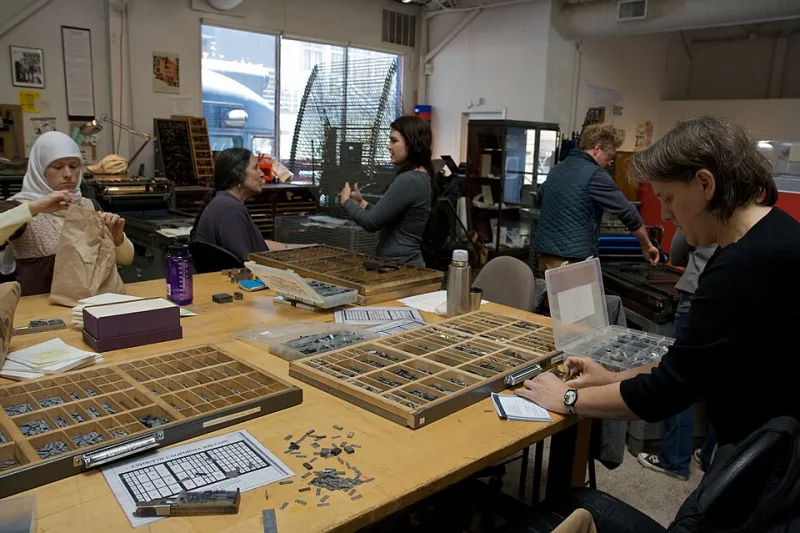
Photo: Marcin Wichary, CC BY 2.0, via Wikimedia Commons
In a converted warehouse on Portland's east side, a twenty-six-year-old printer named Dana Ok slides a hand-cast copper alloy character into a composing stick. The glyph is not a letter but a syllabic block — a Korean geulja — dense with strokes, balanced like a small piece of architecture. It is the kind of character that appeared, inked onto mulberry paper, in a Buddhist text printed in Korea in 1377: Jikji, the oldest extant book printed with movable metal type.
Ok is part of a quiet but measurable turn in American craft printing. Letterpress workshops, risograph studios, and zine fairs have long been havens for people weary of frictionless screens. What is new is the alphabet on the press bed. Increasingly, young printers are setting type in Hangul, the Korean script, and in doing so they are touching — sometimes unknowingly — the very tradition that produced the world's first surviving printed book.
The Craft Fair as Classroom
Walk the aisles of events like the National Stationery Show's indie offshoots, the annual letterpress gatherings in the Midwest, or the print-focused zine fests of Oakland and Chicago, and you will notice something: tables displaying Hangul type are no longer curiosities. They are crowd magnets.
Part of the appeal is visual. Hangul's stacked syllable blocks were engineered in the fifteenth century to be legible and learnable, and they possess a geometric richness that Latin type rarely achieves. Set in metal at eighteen picas, a Korean character reads like a small mandala. Printers describe the experience of composing it as closer to assembling mosaics than to typing.
Part of the appeal is historical. The story most American students learn — that printing began with Gutenberg in Mainz around 1450 — is incomplete. Korea's Goryeo dynasty was casting bronze type more than a century earlier, and Jikji, printed at Heungdeok Temple in Cheongju in 1377, survives today in the Bibliothèque nationale de France as proof. When hobbyist printers learn this, many describe the discovery as a kind of vertigo: the craft in their hands is older, and geographically farther flung, than they had imagined.
Rebuilding the Tools
Recreating Jikji-style type in an American garage workshop is not simple. The original Goryeo typefaces were cast in bronze using molds whose exact mechanics remain debated by scholars. Contemporary hobbyists improvise.
Some work with type founders — a handful of commercial foundries in the United States now accept commissions for non-Latin matrices. Others go further, machining their own molds, melting lead-free casting alloy on kitchen stoves, and filing each character by hand. A few ambitious printers have partnered with university metalworking programs to cast type in bronze, the closest practical approximation of the Goryeo originals available outside specialized labs.
The challenges are instructive in themselves. Hangul's dense stroke patterns demand deeper relief and more even ink distribution than most Latin faces. Printers report burning through packing paper, adjusting roller pressure repeatedly, and learning — viscerally — why the Goryeo court invested so heavily in type foundries and papermaking. The material constraints of the craft are the history lesson.
Screens Off, Hands On
Why is Generation Z, raised on infinite digital fonts available for free, drawn to a medium that requires molten alloy and hours of hand composition? Interviews with workshop participants surface a familiar set of answers: tactility, slowness, permanence. But there is a newer note as well — a hunger for origins.
Many young printers discovered letterpress through Korean-American cultural programming, K-drama set design, or social media videos of Hangul type being cast. For them, setting Korean type is both an aesthetic practice and an act of historical correction. Printing a broadside from hand-set Hangul makes an argument that no lecture can: that the printed book has more than one ancestral home.
Museums and cultural institutions have begun to notice. Several American university libraries with East Asian special collections now host letterpress demonstrations featuring replica Korean type, and attendance skews dramatically young. The Jikji Museum has heard from workshop organizers across the country seeking accurate facsimiles and historical context to anchor their events.
An Old Book, a New Audience
There is a certain symmetry to this revival. Jikji was itself a teaching text — a collection of Buddhist teachings compiled by the monk Baegun, intended to be copied, printed, and circulated so that wisdom could outlive any single scribe. The monks who printed it in 1377 were participating in a technology of dissemination, not preservation. The book survived by being used.
The young printers casting Hangul in American workshops are, in their own way, continuing that project. Each impression pulled on a hand-cranked press is a small act of transmission — of script, of craft knowledge, of a history that deserves wider telling. The screens will keep glowing. But in a growing number of American studios, the older light of ink on paper is gaining ground, one cast character at a time.